Chapel Cottage
The LighthouseChapel Cottage is Adrian Boyde’s dwelling on the headland, set close to the chapel where his body is discovered. Its everyday domestic details—the desk, the breakfast plate, the dry bathroom and the made bed—place ordinary life beside the investigation’s central death. When the cottage is searched, those details become evidence: they indicate that Boyde did not sleep there and help locate the scene of his death in the chapel.
Setting and Interior
The cottage opens onto a stone patio at the cliff edge through a central door flanked by windows. The sitting room is bright, with a desk positioned before the window. A large stone grate, incorporating what appears to be a bread oven, stands opposite two high-backed armchairs; kindling and small logs are stacked nearby, and a reading table and modern angled lamp sit beside one chair. A greasy plate and the smell of bacon give the room the immediate traces of a meal, rather than the impression of an abandoned interior.
The cottage stands across the scrubland from the chapel, which is roughly fifty yards away over stone-littered grass. The two places are close enough to form one landscape, yet distinct in purpose: the cottage has a sitting room, bedroom and bathroom, while the chapel becomes the place where Boyde’s body is found. At night, the cottage has no lights, with the pale windows of Combe House visible farther off. The arrangement places Boyde’s private home between the cliff and the chapel, and makes the short crossing between the buildings consequential to the investigation.
Boyde and the Box
Dalgliesh visits the cottage after seeing Mrs. Burbridge leave the chapel. Boyde is seated at the desk and explains that she usually attends seven o’clock Mass on Sundays. The visit thus begins within the ordinary pattern of the island: a call made at a convenient moment, in a room that still carries signs of food and daily use.
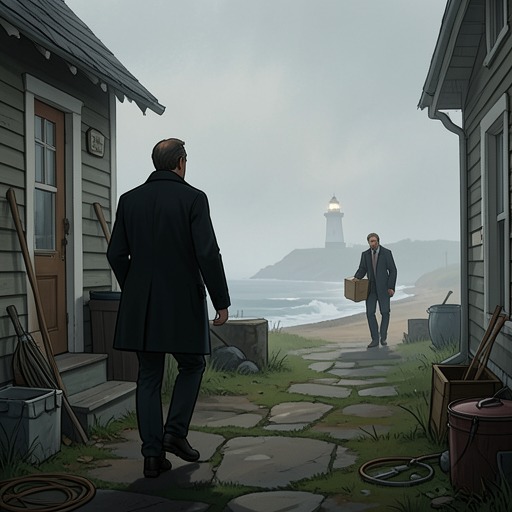
Later, Dalgliesh sees Boyde emerge from the darkness carrying a long, narrow box on his shoulder. Its shape briefly suggests a coffin, although Boyde carries it lightly. Dalgliesh recognizes it as the box that had held the green embroidered cope in Mrs. Burbridge’s sewing room. Boyde brings it to the cottage door, hesitates, then picks it up again and heads toward the chapel. The movement links the cottage to the object that will cover Boyde’s body, though the box itself does not establish what happened between the two buildings.
The Search and Discovery
When Dalgliesh goes to the cottage the following morning, the door is unlocked. He calls out, crosses the sitting room and climbs the wooden stairs to check the bedroom. The counterpane lies over a bed that is made; turning it back confirms that it has not been slept in. He then crosses the grass to the chapel, where he finds Boyde dead on the stone floor beside the improvised altar, beneath the cope. The long cardboard box rests on an opened folding chair, with tissue paper spilling from it.
At the cottage, Kate Miskin draws the immediate inference from the made bed: Boyde did not sleep there, so he died where they found him, in the chapel. The observation is modest but important. Rather than treating the cottage as the presumed scene simply because it was Boyde’s home, the investigators use its undisturbed bedroom to distinguish his residence from the place of death.
Evidence and Significance
The bathroom adds another set of physical details to the search. The bath and basin are dry, and the towels remain in place. Kate notes that the showerhead and taps might bear fingerprints, but the team cannot examine them fully until technical support can safely attend. Their immediate task is to secure the cottage and protect what is there. They bag the towels in the hope of recovering DNA and arrange for them to go to the laboratory.
The cardboard box also becomes part of the evidence to be retained; the team plans to send it with the body, although it is too large for the available exhibit bag and they must obtain a plastic bag from the house. The cottage is therefore not merely background to the discovery. Its bedroom helps establish where Boyde did not die, while its bathroom and the box preserve possible traces for later examination. The contrast between an apparently ordinary home and the chapel’s transformed space gives the investigation a concrete route from domestic observation to forensic inquiry.